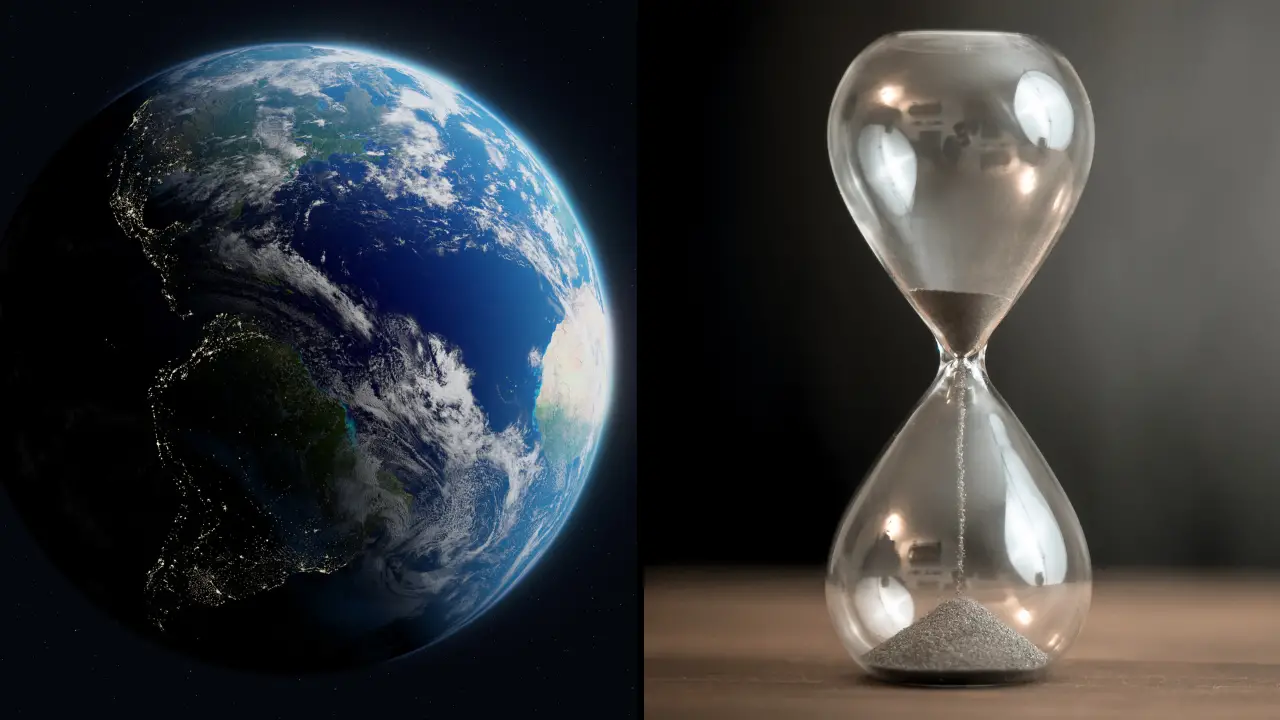
Today is going to be the shortest day in history, as Earth’s rotation has unexpectedly become faster.
If it feels like time is slipping away today, you’re not imagining things.
According to scientists, Earth will experience the shortest day ever recorded on that date – and it’s all because of the moon.
Our planet’s rotation is speeding up slightly due to a shift in the moon’s position. Experts say the moon has moved closer to Earth’s poles, triggering a minor increase in the planet’s spin.
As a result, July 9, 2025, will be a fraction of a millisecond shorter than usual, by about 1.3 to 1.6 milliseconds.

While this may not seem like a big deal, researchers explain that even the smallest variations in Earth’s rotation are significant.
“This is an unprecedented situation and a big deal,” said Duncan Agnew, a geophysicist with the Scripps Institution of Oceanography at the University of California, San Diego, to the New York Post.
He added: “It’s not a huge change in the Earth’s rotation that’s going to lead to some catastrophe or anything, but it is something notable.”
These tiny changes in the planet’s spin can result from a number of influences, including seasonal changes, seismic activity, and even melting ice caps.
But the moon’s gravitational pull remains one of the most influential forces affecting Earth’s rotation.
This isn’t an isolated event. Scientists have observed a trend of increasingly short days since 2020.

2025’s July 9 event will mark the sixth such occurrence in just five years, and it’s not stopping there.
The International Earth Rotation and Reference Systems Service (IERS), the global authority that monitors Earth’s rotation, forecasts that two additional short days (on July 22 and August 5) are also on the horizon.
Eventually, the accumulation of these shortened days will require what is known as a ‘negative leap second’ – a rare correction to atomic clocks.
This would involve subtracting a second from official timekeeping to align with Earth’s faster rotation.
According to IERS, this adjustment is expected to occur in 2029, marking the first time such a step has been taken.
“This is yet another indication that we’re in a very unusual time,” Agnew remarked.